Here, there is an explorer, who comes across an archive / grave / lab / tomb / home, filled with these things, our things, familiar / unfamiliar. This unsettled discovery emerges out of some parallel time, both my own and someone else’s. The room is decaying with the ambiguous sinews that bind us and our bodies together / apart. Here you can smell this impulse to keep, to hold, hide, to treat this with caution and dig, but don’t touch. Here, what it wants you to do is to breathe it in. Hold the trove, hide in it, nurture its parts and find out where they are from and where we are going. It’s you and them and us, at our most spindly and toxic. You must board the ship that sails nowhere, arriving at this vertiginous point, through invention. Rolling in the dirt, piecing these objects together, pulling at the strings which take you, and each other from place to place.
An explorer will tell you that there are places you can find that contain the force of a compacted mass of reality.* You fall into them, imbued over time with marks and ritual. Here is where they meet, they will tell you – the folds of time thinning, transparency leeches through the floor, and you could fall through it if you find the latch.
Éliette Brunel Deschamps, Christian Hillaire and Jean-Marie Chauvet.
In the limestone of the Ardèche three friends scrambled at some rocks near Pont d’Arc, the stone arch hanging over the water, mirrored in a way that extends itself into a portal, the gates of the Ardèche. Bear skulls, stalagmites and stalactites, human footprints, hibernation hollows indented into the floor. A bear skull rests atop a stone plinth, and lining these cave walls were paintings, frescoes of horses and boars, clusters of red ochre spots and scratches behind 20,000 years of calcite, charcoal littered on the floor.
That night they made it through less than half of the site, turning on their heels as their torches began to fade, concealing the entrance they had scrambled through on their way out. Their third visit was planned for Christmas Eve 1994, still in secret, but now in the company of two more explorers. Armed with stronger torches, they lay plastic sheeting to mark their route through the cave. They made their way deeper this time, new discoveries falling out of the darkness as their torches searched the corners. Now they made it to the final chamber. Here, they stood in front of a fresco, layers of hunting lions, spewing with immediacy – the charcoal marks of a moving herd in a moment of such expansiveness – it eats into your heart. At once they have closed the gap between thousands of years of silence, the charcoal so fresh it’s like we have interrupted something living within the dark, outside of time. These moments were described as ones of madness and responsibility; standing within the depths of the Ardèche, they opened a bottle of champagne – now custodians of an unfathomable trove from an elsewhere time.
In the Chauvet cave, these friends were staring straight into the void. In the dark, time folds on itself, stitches holding a reticulated history of us/them. They had arrived at the point where the axis of time and place intersects, marks of moments in time with a stroke of charcoal, a torch scrape on the wall, handprints, a champagne cork.
These are the places where the explorer faces the infinite – time / death / art / and joy, meeting something here in the dark which is so familiar.
It is here, here is where we meet.
You step outside this cave / lab / archive / grave / home / tomb and re-enter the wind rush of time passing. Underneath, it rings in silence, and hums in the dark; everything inside the cave is present and nameless.**
*This privileged point comes from Gilbert Simondon’s On the Mode of Existence of Technical Objects, and his writing on returning to a “magical mode of existence,” a unity that precedes the separation of figure and ground.
**John Berger’s title for his novel Here Is Where We Meet, where stories meet across time and disparate places… and his protagonist’s narration of moving through the Chauvet cave, which Berger himself visited in 2002. From his writing on the caves I ritually cite his words: “Step outside the cave and re-enter the wind-rush of time passing. Reassume names. Inside the cave everything is present and nameless.” I visit these caves in his words – closed now to visitors, I will visit the replica.
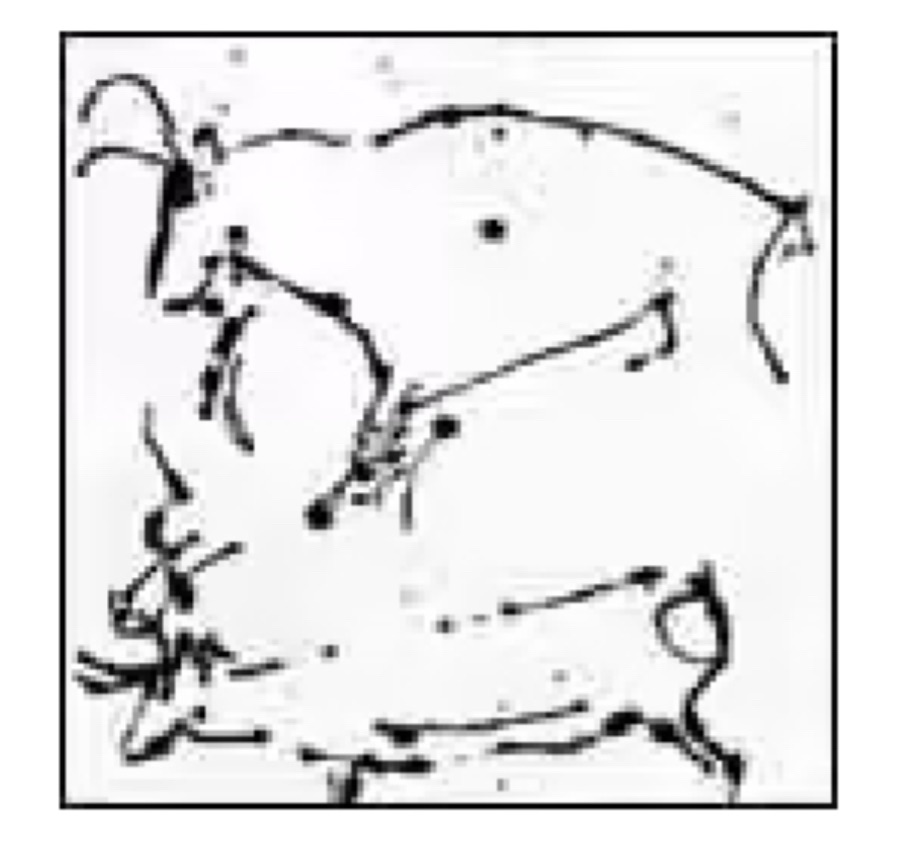
*John Berger’s drawing of Cro-Magnon cave paintings in Chauvet

