
Trump and Musk celebrating the New Year, reshared by @WuTangKids on X, 2025
A few years ago, I went through my account and erased my digital self from Twitter. I deleted all my tweets about new Japanese House records, and The 1975 plays on Radio 1 from when I was 14, the best one being when Jamie Oborne retweeted me. I literally couldn’t believe it, the manager of my favourite band wanted to share my tweet with his world. Jamie’s retweet made me feel like an incredibly mature and astute person, flinging my digital avatar into the inboxes of my favourite bands, but I was still a 14 year old seething about not getting tickets to a tiny gig they did at the Dome that year – a heartbreak I can still feel in my throat. My twitter stardom did not reflect the truth of my world, but it had lulled me into a false sense of proximity. The internet was my portal to imagine a different reality for myself. All of this had to go. I am a self respecting adult now and I can’t afford for these past escapades to taint my totally mature and suave digital footprint.
Deleting Twitter was also self-preservation move. I think Instagram being centred around pictures made it feel more personal, whereas Twitter had this sort of untethered quality filled with anonymous jabs and things that should really be prefaced by ‘thinking out loud here’. I seemed to step away as Twitter started embedding itself deeper into global politics. Trump had just been banned for tweets deemed partially responsible for the Capitol riots on January 6th, 2021. Fast-forward four years, and Elon Musk has bought the platform for $44 billion, now rebranded as X. Trump is back too, tweeting his way through political hands-free mode while his social media assistant allegedly dictates his thoughts in real-time. Solidifying this platform as the chosen method of political communication with established and potential digital followers.
So I’ve come to realise that the problem with me leaving Twitter, is that I’m leaving this new political stage unmanned. As our existing political systems continue to fail so many, this turn to social media to amplify and protect ‘free-speech’ is in part a product of how unheard we all feel by those we elect to power; that sentiment is bipartisan. X is now a global, unelected political arena: no whips, no salaries, no geographical borders. Its owner wields massive influence not just in the U.S. but also in Germany and the UK, dirtying his hands in their politics from the safety of his X profile and bank account. Social media has also been a brilliant and valuable force in global politics; its ignited movements, raised huge amounts of money, and fostered empathy among strangers online. But with an algorithm driven by an attention-hungry oligarch, the platform has become a rocket-fuelled enabler of extreme conspiracy culture, catapulting it from the fringes to the centre of our political discourse.
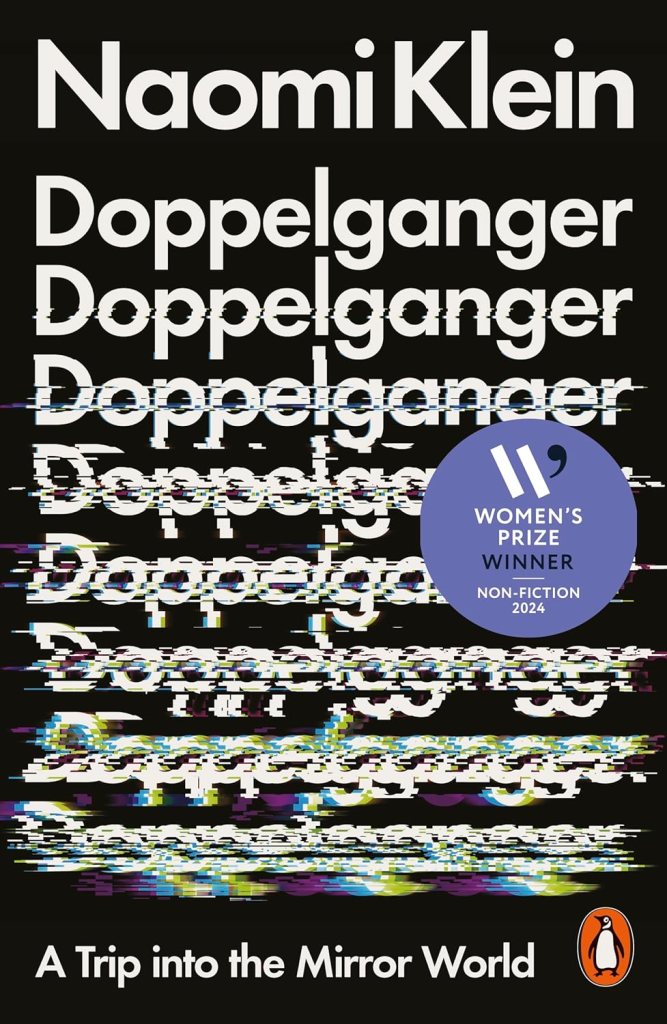
Naomi Klein’s 2023 book Doppelganger explores the breakdown of truth in a post-pandemic world shaped by late-stage capitalism. She begins with her own “doppelganger” Naomi Wolf, a feminist writer turned conspiracy theorist who now moves within these anti-vaccine, state-suspicious digital circles led by figures like Steve Bannon, Trump’s former chief strategist. Klein grapples with the unsettling digital conflation of her identity with Wolf’s, a confusion that worsened as Wolf’s words became more unhinged online. She uses this phenomenon to investigate this post-truth rabbit hole that so many have fallen into. This digital doubling she experienced pulls her deep into what she calls the “Mirror World.” In this world, the political left, whom we often consider “the sane ones,” occupy one side, while the “far out,” as Klein describes them, occupy the other. The left often assumes that those on the other side of the Mirror will eventually come to their senses, recognizing that their “truths” are grounded in mistrust and skepticism rather than facts. Looking away may feel easier, because sometimes it’s too painful to look closely. But as Klein recounts from her time on the other side, the “far out” are unflinchingly focused on the left, scrutinizing its mistakes and proposing their own solutions.
Ultimately, Klein’s Doppelganger offers a critical unpacking of the fractured nature of truth in today’s digital age. The “Mirror World” is a place where the lines between left and right, fact and fiction, have blurred beyond recognition. Yet, in understanding this strange digital doubling, we may begin to see how these fractured worlds are both reflections of each other and inseparable from the larger political landscape we inhabit.
So, I am back on X. I rejoined when the riots broke out across the UK last year, I wanted to understand what the “far out” were saying. What was inciting this widespread, organized violence across the country? In Klein’s tradition, I am now deep in the algorithmic hole of Musk’s conspiracy circle; weather manipulation, anti-vaxxers, and more Trump talk than I know how to unpack. The app sits on my phone, tempting me to look long enough to fall into its trap. I can’t say this is doing wonders for my wellbeing, but I no longer think it’s productive to remove myself from these challenging, distressing circles of misinformation. Eventually, we’ll have to face the fact that we’ve spent too much time on the outside of this crucial political stage, allowing the Mirror World to grow unchecked because we don’t know how to bridge the gap between us.
For now, I’m staying firmly X-adjacent – an observer of Musk’s Trumpland attention economy. I watch my Mirror World through two-way glass, rather than one, trying to find my footing within our new digital commons.

I can’t stop thinking about this book….
https://www.penguin.co.uk/books/453962/doppelganger-by-klein-naomi/9781802061956
Thank you
 lonely disco dancer